
Diode Laser Hair Removal for Men's Back
Depilazione Alma Laser
- Session duration: 45 min
- Prezzo: 240 €
Tutto quello che c’è da sapere sull’epilazione con il spprano laser
Beauty news
Quante sedute devo fare con il diodo laser per rimuovere definitivamente i peli? Posso fare il trattamento col soprano laser sul viso? È dolorosa una seduta di epilazione progressiva definitiva?
In this article, we will try to clear up all your doubts about diode laser hair removal, the cutting-edge technology for removing unwanted hair. In fact, no other professional equipment achieves the same results in the field of hair removal. Be careful, it's hair removal, not shaving, because the hair is completely removed and the follicle is destroyed, so it cannot grow back.
Spiegheremo anche perchè non si parla di epilazione definitiva ma progressivamente definitiva, come viene effettuato il trattamento all’interno dei Centri di Estetica Avanzata Hello Beauty e cercheremo di sfatare qualche mito dovuto alla disinformazione sull’argomento epilazione.
We hope that by the end of this article, you will have found answers to all your questions and that you no longer have any doubts about choosing the diode laser treatment over traditional aesthetic methods, such as the costly and good, but above all, old-fashioned waxing (shaving).
What are the benefits of laser treatment?
I principali motivi per cui scegliere l’epilazione con il soprano Laser rispetto ad altre tecniche:
Money and time saved: Although the cost of the treatment is higher compared to traditional solutions, in the long run, it proves to be a great investment, considering that you no longer have to worry about buying razors, depilatory creams, etc. Not to mention, of course, the costs of waxing appointments.
Goodbye to irritations and ingrown hairs (folliculitis): Laser treatment is currently the best solution for removing unwanted hair, as the follicle is destroyed, preventing regrowth and eliminating the possibility of ingrown hairs developing.
Speed and efficiency: Laser sessions are quick; for example, a small area like the underarms is treated in about 20 minutes. Of course, the duration increases slightly depending on the size of the area to be treated.
How many sessions do I need to have to permanently remove hair?
The human body has millions of hair follicles, but not all of them actually contain a hair, because follicles can be either active or inactive. This difference is very important to fully understand the timing of results with laser treatment and why this method is defined as progressively permanent.
Durante una singola seduta col soprano laser vengono eliminati più o meno tra il 20% e il 60% dei bulbi attivi presenti nella zona trattata, ma solo quelli in cui il pelo è in fase anagen, cioè in fase di crescita. Per questo motivo viene richiesto di depilare la zona un paio di giorni prima della seduta.
However, be aware that when the human body realizes it has lost a follicle, it may activate an inactive one. The activation of inactive hair follicles is influenced by numerous factors, the most important being age, which is closely linked to hormone production.
It’s not hard to understand, then, why multiple sessions are necessary to achieve satisfactory results with laser hair removal, in order to eliminate all hair follicles, both active and inactive.
The duration of diode laser treatment is a few months: about ten sessions are performed, with the first ones closer together, followed by monthly sessions, and then gradually reduced to a few maintenance sessions.
In summary, it can be said that to achieve optimal results and have perfect hair removal by summer, the recommended time to start treatment is at the beginning of the year.
Which areas of the body can be treated with laser hair removal? Are some areas more or less painful than others?
The Diode Laser can be used for hair removal on almost the entire body, even in more delicate areas such as the bikini line and face. Legs, underarms, shoulders, stomach, upper lip, etc., are all areas where excellent results can be achieved, also helping to avoid the discomfort caused by traditional hair removal methods, such as irritation and rashes.
The only areas where the treatment cannot be performed are around the eyes and, in the case of male hair removal, the testicle area. The area around the eyes should be avoided due to the risk of serious damage if the laser comes into contact with the retina, while for the testicles, the major risk is causing damage that could lead to sterility.
Un altro caso in cui il trattamento con il soprano non può essere effettuato è la presenza di tatuaggi nella zona da epilare, infatti il laser andrebbe a schiarire il tatuaggio stesso, provocando anche molto dolore.
In general, a laser session is referred to as painless; at most, you may feel a sensation of warmth on the skin or a slight tingling.
Phases of the Treatment
BEFORE – In the two weeks preceding the 808 nm Diode Laser treatment, waxing is not recommended, but the area to be treated must be shaved (because the hair must be in the anagen phase). You should not sunbathe or use tanning beds/lamps for 3 days before the session.
DURING – The area to be treated will be shaved by the operator if it hasn't already been shaved by the client, and a gel with soothing and conductive properties will be applied. Both the operator and the client must wear protective glasses to avoid the laser coming into contact with the eyes, as it could cause serious damage to the retina. For the same reason, mirrors and objects that could reflect are removed from the treatment room.
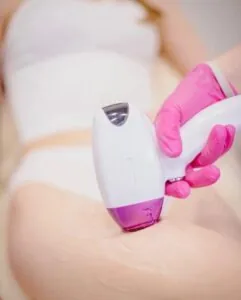
L’operatrice procederà poi al trattamento con il laser nella zona depilata.
AFTER – Once the treatment is finished, you can comfortably return to your daily activities. You may only experience a sensation of warmth and redness in the treated area. This sensation is common and can last a couple of days. For the 3 days following the treatment, you should not sunbathe or use tanning beds/lamps.
Per avere ulteriori informazioni specifiche vi consigliamo di leggere l’articolo sulle indicazioni e controindicazioni del soprano ,